Showing posts with label ISSI. Show all posts

Wednesday, July 25, 2007

ISSI - Week Two Highlights

Much like week one, the Institute provided an abundance of content material, many teaching strategies/models, and excellent cultural opportunities. Here are the highlights:

Silk Road Bayram

On Sunday evening (7/15), the participants attended the Silk Road Bayram. Put on by the Inner Asian and Uralic Resource Center @ Indiana University, the Bayram provided a great deal of exposure to the music and culture of the region.


Nyaka AIDS Orphans School

Many of us have asked ourselves, "What can one person do to help solve the world's problems?"

T. Jackson Kaguri is a living example that answers that very question. Having grown up in the small rural village of Nyaka in southwest Uganda, Kaguri knew what devastation was being wrought by the AIDS epidemic. He and his wife decided that something needed to be done to care for the orphans of AIDS victims. With little money, they started the Nyaka AIDS Orphans School. The project has grown to include a second school, and with his boundless energy, Kaguri is planning future projects.

As you may have noticed, I have listed the Nyaka School on my list of worthy causes. You can find out how to contribute by visiting the school website. I know that they are currently looking for used (but functioning) laptop computers.

Giving Back in Bloomington

On Tuesday (7/17), Institute participants went out into Bloomington to perform community service.

Given the choice between the Community Kitchen, the Shalom Center (which also includes a kitchen), and a Bloomington Parks and Rec project at Lake Griffy; I could not pass up the chance to spend some time on the trails. And it really was hard work!! Those of us at the lake hauled mulch up onto the trails while others worked to clear the trails for hikers. It was a nice diversion from the intensive seminars which normally filled the afternoons.


more later


Monday, July 23, 2007

ISSI - Saturday Trip to Indianapolis

Saturday, July 14th

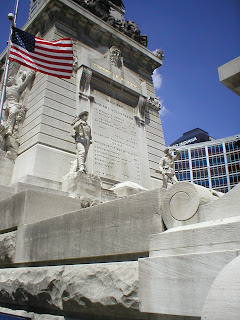
My first time in Indy. We didn't really have enough time to see everything, but we did our best. Here are some pics.


The Soldiers' and Sailors' Monument


Colonel Eli Lilly Civil War Museum


The World War Memorial

Day Six: International Studies Summer Institute - Rounding Out Week One

Friday the 13th began with a round table discussion on the role of globalism in various regions around the world. It really amounted to a mixed bag, with those studying the underdeveloped regions - Latin America and Africa primarily - painting a negative picture of globalization. For those studying the developed and developing regions the picture was a bit brighter.


What I would have really liked to hear was a discussion that accepted the reality of globalization for the foreseeable future, and then ways in which the various regions can learn to grow within a globalized world.


The Role of Media in World Affairs
To address this important topic, the film Control Room was shown and discussed. Unfortunately, it presented only a biased view of the war in Iraq and the media coverage of Al Jazeera. Without balance it is difficult to have a serious discussion on any polarizing topic, particularly not one of this magnitude. It was really a missed opportunity.


Summer Night of Lotus!!

After a day of intense discussion of important issues, participants had a chance to relax and enjoy a diverse collection of musical groups. The Summer Night of Lotus concert allowed everyone to get to know each other a little better. Another one of the real strengths of the Institute has been the effort to provide as many of these cultural activities as possible. For myself, teaching geography is far more enjoyable when I been exposed to some of the cultures about which I teach.

Saturday, July 14, 2007

Day Five: International Studies Summer Institute

Technology is the Order of the Day

Thursday was loaded with technological opportunities. Marc Cohen, senior research fellow at the International Food Policy Research Institute, presented his material via the Internet utilizing videoconferencing (Polycom). While the research and content was interesting and informative, it was again almost overshadowed by the presentation of the unbelievable teaching possibilities via Internet video. Being able to bring the world into your classroom will increase the impact on students almost immeasurably. What a perfect fit for a geography class.


Fishbanks
Fishbanks is a great simulation game for teaching food sustainability, but for me its application in the 7th grade classroom would be a serious challenge. Its introduction and execution would require a great deal of time, so I don't know that I'll find great use for it in my classroom. However, given the right circumstances its impact could be great.


Tibet in Bloomington

Wow, what a great night at the Tibetan Cultural Center in Bloomington. Who would have thought that we'd find such an amazing facility right here in the middle of Indiana - certainly not me. Like much of what we're doing here, the exposure to different cultures will pay huge dividends in the classroom.


Buddhism as a philosophy, more than a religion, is not something that I had really considered. Nor was I aware of the desire of Buddhists to exist in cooperation with other faiths. This is something that was made clear by Arjia Rinpoche (pictured), the monk that oversees the operation of the center. In fact, one display in the temple immediately jumped out at me. It contained important components of various faiths.

And who can't forget the food. We were treated to a tremendous dinner of traditional Tibetan dishes, followed by chai and butter teas.

Thursday, July 12, 2007

Days Three and Four: International Studies Summer Institute

Sorry for the lack of a post yesterday, but we have been working long days and I've been enjoying my limited free time in the evenings.

We have had a couple of packed days, so there is much on which to reflect. I was just mentioning to one of my colleagues this morning that one of the real strengths of the Institute is the heavy emphasis on teaching strategies and modeling. This has been especially true of the past two days.

We began Monday by viewing the film T-Shirt Travels: Cast Offs for Africa, which deals with the problem of economic development in Zambia. To illustrate the problems in this African nation, the director, Shanta Bloemen focuses in on one family that is active in the trade of used clothing shipped in from the West, most notably the United States. The film brought to mind questions about the impact of globalization on the developing world, and, perhaps, questions about the role of charity and charitable contributions by citizens of the developed world.

The film, while expensive at $350 ($75 to rent), could serve as excellent teaching tool when dealing with the aforementioned topics. It is a shame that the film has not been made more accessible to teachers.

Perhaps the highlight on Tuesday (and then continued on Wednesday) were the sessions on the use of the deliberative process in the classroom. Kevin Zupin, social studies teacher and Indiana state coordinator for the Integrating International and Civic Education Project(IICE), and Manjari Singh, a PhD candidate at Indiana University and IICE project assistant, utilized the Choices Program curriculum, designed by Brown University's Watson Institute for International Studies, as the content around which they introduced the deliberation teaching model. Both their model and Choices have been the highlights of the week so far.

It is always a challenge to get some students involved in classroom discussion. The deliberation process is designed to tear down some of the walls and inhibitions that many students have built up around themselves. One of the culminating activities in the process is the "fishbowl" which allows discussion to take place amongst a small group, while at the same time being observed by the rest of the students, those outside the fishbowl. By spending time teaching the process - something we don't often due with our intense focus on content - a level of comfort is achieved that allows students to fully participate.

I will certainly utilize this teaching model in my classroom. Its applicability in the social studies in really endless.

International Trade
Economist Mohammad Kaviani's presentation on market economy and international trade was, I think, a bit hard to swallow for some participants. As a believer in market economics I did not find much to dispute. That said, it is clear that for the market to work an environment of free trade must be in place. This is not the case today, most importantly with regards to U.S. trade policy.
Overall, not much new for me here, but I can see myself applying some of the teaching models to economics and international trade.
I should be caught up with my posting by tomorrow

Monday, July 9, 2007

Day Two: International Studies Summer Institute

Our first full day is drawing to a close. It certainly feels as if we have been here longer, as our day provided at least a week's worth of thought provoking exercises and practical lesson models that will definately find their way into my classroom.

In teaching international studies to middle school students, one is immediatly met with a series of challanges. For example, demonstrating the relevance of global issues to students is essential if one hopes to move beyond the simple memorization of facts and figures.

Just as important is demonstrating the connection between various important international issues. Examining issues in a vacuum severely limits the students' ability to fully understand how the various issues are interconnected and how practical remedies can be devised to confront the underlying root causes of global problems.

Today's activities included a number of lessons that can be applied to a wide array of issues and concepts. As the files come available I will post detailed descriptions here. I will certainly leave Indiana with my belief in professional development more deeply ingrained. Only in an environment such as ISSI can teachers access the methodological creativity developed by many educators over many years.

And that was only the first day.

Sunday, July 8, 2007

Well, I've just arrived at Indiana University for the International Studies Summer Institute. Successful connection of flights in Atlanta, all luggage accounted for, and a nice single dorm room. Things are off to a good start.

I'm excited about getting this blog kicked-off here at the institute. I come into not knowing exactly what to expect, but eager for what lies ahead. About half of the 28 participants are from outside the United States - from places like Georgia, China, Ghana, and Nepal. While we do have private rooms, I am sharing a bathroom with a teacher from Nepal. Having taught about Nepal to 9th grade geography students - and having absolutely no experience with the country or its people - this contact alone will be rewarding.

We meet for dinner in about 30 minutes, so I'll sign off for now. I will try to post daily over the course of my two-weeks in Indiana.